Moss, lichen, algae: your roof is sending you a warning signal. Learn how to treat it effectively from the ground, without a ladder, without risk - with the professional low-pressure method.
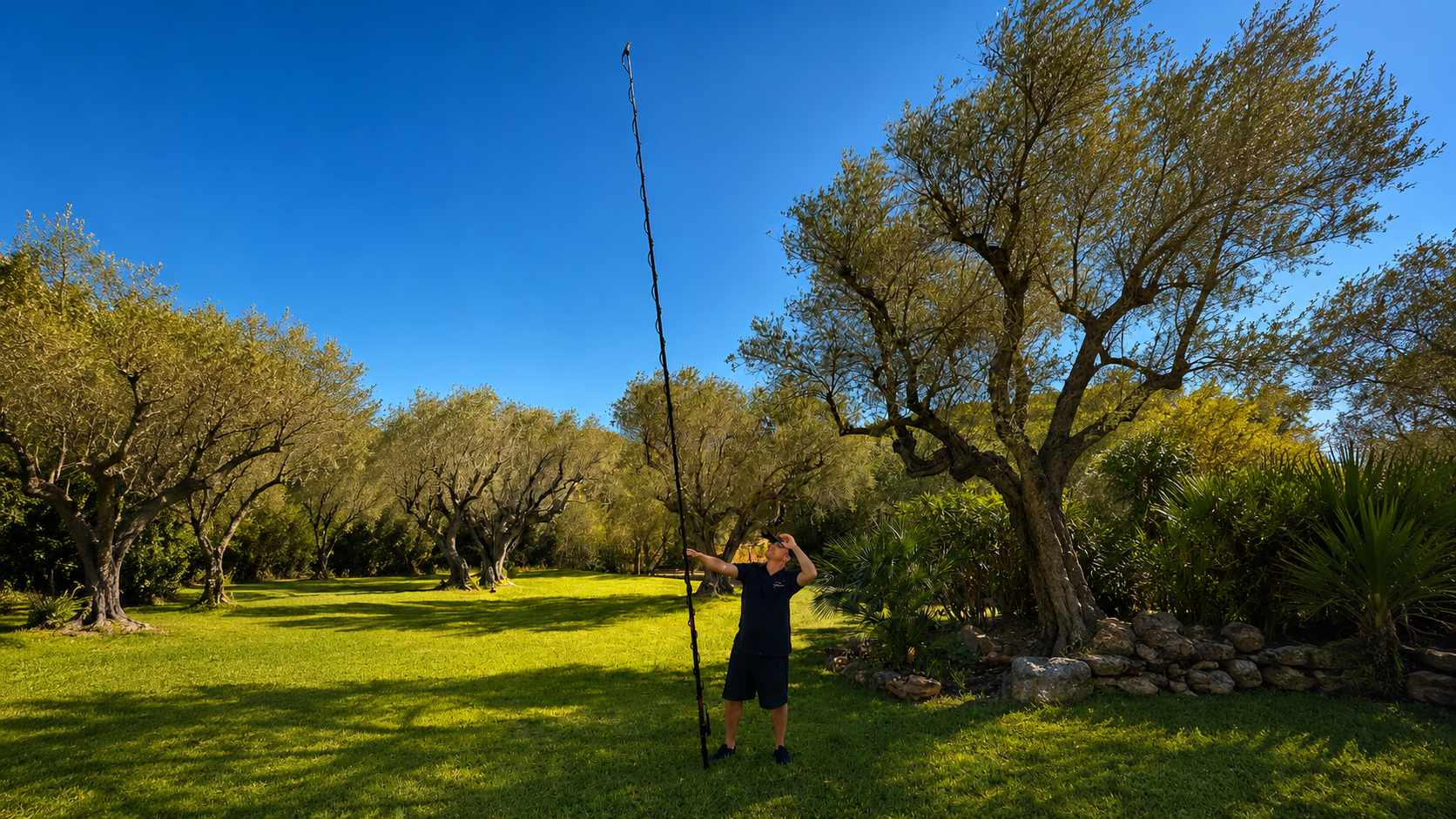
Yes, it is possible to remove moss from a roof without a ladder, from the ground, using a telescopic pole (3.2 m to 5.4 m depending on the height of the building) and a low-pressure sprayer set between 4 and 6 bar. This method eliminates any risk of falling, protects the tiles and works just as well on a single-storey house as on a two-storey one (R+2). It is a superior alternative to the high-pressure washer, which damages the protective coating of roofing materials.
The build-up of moss, lichen and micro-algae on a roof is not merely an aesthetic nuisance. Over time, these organisms retain moisture, make materials porous and expose the building to cracking risks under the effect of frost. Yet traditional roof maintenance rightly puts people off.
Climbing onto the tiles is heavy, complex and inherently dangerous. In France, falls from height remain, according to reports from the Assurance Maladie Risques Professionnels and the OPPBTP, one of the leading causes of serious and fatal accidents in the building sector. Faced with this observation, the development of remote spraying equipment now makes it possible to treat surfaces directly from firm ground. This method, far from being a fallback solution, stands out as a rational approach combining absolute safety, working comfort and technical efficiency.
Contents
- Why working from the ground is safer (and more effective)
- High pressure vs low pressure: how to choose to protect your tiles
- What equipment do you need to remove roof moss without a ladder?
- How to remove roof moss without a ladder: step-by-step guide
- The 3 mistakes that cause ground-based moss removal to fail
- FAQ — Your frequently asked questions
1. Why removing roof moss from the ground is safer (and more effective)
Avoiding the use of a roofer's ladder or the tedious setting up of scaffolding profoundly changes the dynamics of a maintenance job. Access to the roof no longer depends on heavy logistics or the installation of lifelines and harnesses, equipment whose handling requires specific training and certified compliant anchor points. For a tradesperson who is just starting out or for a demanding homeowner, working from the ground instantly eliminates the fear of heights and the stress linked to verticality.
In the field, renovation experts observe that an operator whose feet are stabilised on the ground works with markedly greater precision. The muscle fatigue caused by holding an unstable or crouched position on a roof slope disappears. This direct reduction in physical strain - a central pillar of quality of working life and CSR initiatives - guarantees constant attention throughout the intervention. The user keeps a permanent visual overview of the entire roof, allowing them to monitor the uniformity of their application in real time, with no blind spots.
2. High pressure vs low pressure: how to choose to protect your tiles
The reflex of wanting to strip a roof using a standard high-pressure washer is a mistake made far too often. Consumer or non-regulated professional machines deliver jets whose pressure ranges between 100 and more than 150 bar. Such mechanical force proves destructive to roofing materials. Terracotta tiles, concrete elements and slates have a factory surface treatment - an engobe or protective varnish - that fills their natural porosity.
A high-pressure impact tears off this protective surface layer. The material is then left bare, micro-cracked and deeply porous. The direct consequence is a rebound effect well known to roofers: the tile thus degraded absorbs water much more quickly, creating an ideal environment for accelerated biological recolonisation. Moreover, a violent jet directed upwards or at an angle from a poorly controlled position can lift the roofing elements, dislodge the ridge mortars and cause immediate water infiltration into the loft.
Conversely, low-pressure spraying does not seek to mechanically destroy the growth through the force of the water. It relies on saturating the substrate with a biocidal or water-repellent solution that penetrates the material to encapsulate and destroy the roots of the micro-organisms. The technical data sheets of treatment-product manufacturers and the building trade's best practice agree on an optimal service pressure range of between 4 and 6 bar.
This technical range provides the impulse needed to propel the fluid through a telescopic pole without generating unwanted volatile mist. Below a threshold of 4 bar, the flow rate becomes insufficient to obtain a uniform jet at long distance, limiting productivity. Above 6 bar, the risk of product drift under the effect of wind increases massively, leading to losses of active material and a direct environmental impact on the building's immediate surroundings.
3. What equipment do you need to remove roof moss without a ladder?
To compensate for the distance without climbing onto an intermediate structure, the operator must rely on a rigorously selected technical duo: a rigid telescopic pole and a constant-pressure pumping system.
The telescopic pole: rigidity and weight control
The interface between the user and the roof determines the precision of the movement. Aluminium, although very common in the entry-level market, shows real technical limits beyond 3 metres of deployment. Its natural flexibility causes structural sagging under the effect of its own weight and the fluid circulating in the hose. This bending makes controlling the nozzle angle extremely difficult and quickly tires the operator's arms, who must compensate for the oscillation.
Professionals' selection criteria lean towards composite materials. Fibreglass offers an excellent compromise between electrical insulation and robustness for moderate extensions. For great heights, using a carbon-fibre pole is recommended. Its superior axial rigidity prevents any sagging, keeping the nozzle exactly parallel to the roof slope, even at an extension of more than 5 metres, for a weight that remains below the critical mass of one kilogram. A model fitted with an adjustable head lets you adjust the jet's orientation from the ground to follow the pitch of the tiles perfectly.
The spraying system: consistency and autonomy
Forget backpack-tank sprayers with a hand pump. The need to pump constantly breaks the work rhythm and makes the pressure fluctuate, which undermines the consistency of the treatment. As for petrol-powered units, while they offer power, they impose heavy constraints: high noise level for neighbours, fuel storage, exhaust-gas emissions and regular mechanical maintenance.
The technology of self-contained electric sprayers powered by a Lithium-ion battery represents the most efficient and eco-responsible alternative on the market. A battery voltage of 18V combined with a self-priming diaphragm pump makes it possible to maintain a perfectly stable pressure of 4 to 6 bar continuously. The total absence of CO₂ emissions on the intervention site and the silent operation immediately qualify these machines for jobs in urban or densely residential areas.
Tanks with a capacity of 35 to 45 litres mounted on a rolling frame offer an excellent balance: they provide the autonomy needed to treat half a roof in one go without requiring constant refilling, while remaining easily manoeuvrable on the ground by a single operator. Adding a flexible hose extension of around fifteen metres makes it possible to work around the building without moving the main pumping unit.
See our assembly guide for the Pro Sprayer EVO Phoenix 35L
4. How to remove roof moss without a ladder: step-by-step guide
4.1. Step 1: Preparing the job and mandatory protections
The application of surface-treatment solutions, often classified as biocides, requires strict compliance with environmental safety instructions in accordance with the regulations in force (notably the European Biocidal Products Regulation). The first action is to identify the rainwater collectors. Downpipes must be imperatively disconnected from the recovery system or blocked off in order to divert the first flows towards a temporary retention tank. No direct discharge must reach the aquatic environment (watercourse, ditch, pond).
Landscaped areas located directly below the roof edges require special attention. Shrubs and beds must be protected with waterproof tarpaulins. A field technique consists of saturating the surrounding vegetation with clean water before the treatment begins, then carrying out a second rinse after application. This film of neutral water instantly dilutes any stray drops and prevents leaf burn. Also move any vehicle parked nearby to prevent splashes on the bodywork.
Before starting the pump, validate the weather criteria:
- Wind: Speed imperatively below 15 km/h (i.e. less than 3 on the Beaufort scale) to rule out any risk of spray-mist drift towards neighbouring plots.
- Precipitation: No rain forecast at all in the 24 to 48 hours following the intervention, in order to guarantee the fixing and penetration of the active ingredient into the substrate.
- Temperature: Ideal range between 5°C and 25°C. Above this threshold, the risk of flash evaporation nullifies the effectiveness of the solution.
4.2. Step 2: Choosing the treatment based on the substrate diagnosis
The choice of chemical composition depends solely on the state of colonisation of the roof, and not on the height of the building.
For a heavily soiled roof, showing thick patches of moss and encrusted lichen, applying a concentrated curative product (usually formulated with a quaternary ammonium base) is essential. This type of formula acts by direct contact by blocking the vital functions of the organisms. The degradation is slow and gradual: the parasitic growth blackens, dies, then detaches under the mechanical action of rain and wind over a period ranging from several weeks to several months.
See all our roof treatment products
On a clean, recently cleaned or healthy roof, a preventive treatment is applied at regular intervals (every two to three years depending on exposure). Its lower concentration creates an invisible chemical barrier that prevents the germination of spores suspended in the air.
Finally, for substrates at the end of their cycle or made porous by the years, the complementary application of a water-based surface water-repellent is required after complete removal of the moss. This treatment penetrates the pores of the tile without blocking its permeability to water vapour (the material continues to breathe), producing a beading effect that prevents liquid water from infiltrating.
4.3. Step 3: The pole sweeping technique
The consistency of the deposit is the keystone of the treatment's durability. Once the appropriate nozzle is fitted on the pole, the operator must maintain a constant distance of about 30 to 40 centimetres from the tile surface. The logical direction of progress is from top to bottom (from the ridge to the gutter) for saturation applications. This makes it possible to follow the natural direction of water flow and impregnate the nose of the tile, a critical area where moisture stagnates and where the roots settle.
The movement should adopt a smooth, regular horizontal sweeping rhythm. To avoid the appearance of untreated bands after drying, apply an overlap rate of 20% to 30% between each lateral pass. The travel speed must be calibrated to saturate the substrate without causing immediate excessive run-off, which means product loss. Using a multi-jet or flat-jet nozzle (brush type) is strongly recommended to precisely calibrate the width of the jet according to the available distance.
Technical parameters according to the building configuration:
|
Building height
|
Pole configuration
|
Nozzle angle
|
Type of treatment
|
|
Single-storey (< 4m)
|
Retracted pole or 3.2 m
|
Flat jet 40° to 60°
|
Depending on the tile diagnosis
|
|
R+1 (4 m to 7 m)
|
Telescopic pole 5.4 m
|
Wide-angle jet 60° to 80°
|
Depending on the tile diagnosis
|
|
R+2 / steep slope (> 7 m)
|
Pole + rigid extension
|
Mirror jet or tri-function
|
Depending on the tile diagnosis
|
Safety note: When spraying at great height (beyond 7 metres), the firing angle approaches the vertical. The operator must imperatively wear a full face shield and waterproof protective clothing to guard against direct product fallout caused by gravity.
After each work session, the spraying system must be thoroughly rinsed by circulating clean water through the pump, the pole and the nozzles for at least two minutes in order to avoid the crystallisation of active materials and the clogging of the filters.
5. The 3 mistakes that cause ground-based roof moss removal to fail
The absence of direct mechanical action (such as brushing) means that the chemical application must be perfect. Several environmental and behavioural factors can nullify the effectiveness of the operation.
- Application in full summer sun: This is the main trap. If the tile is hot, the water contained in the product evaporates instantly before the active molecules even have time to migrate into the micro-pores of the material or into the lichen's root system. The treatment remains purely superficial and proves ineffective from the first rains. Always schedule your interventions in the very early morning, under a cloudy sky, or at the end of the day when the substrate has cooled down.
- Poor assessment of airborne drift: Working with a pole of more than 5 metres amplifies the effect of the wind on the jet. Even if the air seems calm at ground level, air currents at ridge level can deflect a significant part of the spray. If you visually observe that the jet is deforming or forming a cloud of mist that drifts away from the target area, stop the job immediately.
- Under-dosing through misplaced economy: Treatment solutions have critical concentration thresholds validated by the manufacturers' laboratories. Reducing the dose of product in an attempt to save on volume systematically results in failure in the medium term. The most resistant micro-organisms, such as crustose lichens, will survive and restart the colonisation of the roof within a few months, rendering the initial investment completely useless.
FAQ - Remove roof moss without a ladder: your frequently asked questions
Q1 - Can you really remove roof moss without climbing onto it?
Yes, completely. A 5.4 m carbon-fibre telescopic pole coupled with a low-pressure electric sprayer makes it possible to reach the ridge of an R+1 house from the ground. The saturation of the substrate by the biocidal product is identical to a close-range application, provided you maintain a stable pressure of 4 to 6 bar.
Q2 - What pressure should I use to avoid damaging the tiles?
Between 4 and 6 bar. This is the recommended range for spraying anti-moss and water-repellent treatments. Below 4 bar, the flow rate is insufficient for a uniform jet at long distance. Above 6 bar, the risk of product drift under the effect of wind increases sharply. Consumer high-pressure washers (100 to 150 bar) are to be avoided: they tear off the protective film of the tiles.
Q3 - How long after the treatment can it rain?
You must observe a minimum window of 24 to 48 hours without rain after application. This drying period is necessary for the active molecules to penetrate the pores of the material and act on the roots of the moss and lichen. Always consult the technical data sheet of the product used, which may specify different times depending on the concentration.
Q4 - What length of pole for a single-storey or R+1 house?
For a single-storey house (gutter at ~3 m, ridge at ~5 m): a 3.2 m pole is enough for the low areas, a 5.4 m pole is recommended to reach the ridge. For an R+1 (gutter at ~6-7 m): the 5.4 m pole is essential. For an R+2 or a steep slope, a rigid extension may be necessary.
Q5 - Should the roof be rinsed after an anti-moss treatment?
No, you should not rinse after application. The product must remain on the substrate to act. Successive natural rainfalls will gradually remove the dead moss debris in the weeks that follow the treatment. An immediate rinse would dilute and remove the active ingredients before they take effect.
6. Conclusion and action plan: the essentials to get started
Removing roof moss without a ladder is no longer reserved for specialist companies. It is a rigorous method that protects the physical integrity of the user while preserving the structure of the tiles from the ravages of high pressure. Its success rests on the perfect match between the rigidity of the spraying equipment and compliance with weather windows.
Your immediate action plan to prepare the job:
1. Estimate the actual reach needed: Measure the approximate height of the gutter and the ridge. Count on average 3 metres per habitable level, adding the height of the loft. This technical data validates the choice between a standard 3.2-metre pole or a high-rigidity 5.4-metre model.
2. Carry out the condition assessment of the roof: Visually inspect the nature of the parasites. If the roof shows thick patches of green moss or encrusted yellow stains (lichen), opt for a concentrated curative solution. If the surface shows only black algae streaks or has been cleaned recently, a preventive maintenance treatment will be sufficient.
3. Check the compatibility of the pumping system: Make sure you have a sprayer capable of delivering a stabilised pressure between 4 and 6 bar without interruption, ideally fitted with a Lithium-ion battery to guarantee the fluidity and uniformity of the technical movement.
5 key points:
• Absolute safety: Ground-based treatment eliminates the risk of falling from height, the leading cause of serious accidents in roofing work.
• Material preservation: Low-pressure spraying (4 to 6 bar) saturates the substrate to destroy the roots without damaging the protective film of the tiles, unlike high-pressure washers (100–150 bar) which make them porous.
• Composite equipment required: Fibreglass or carbon telescopic poles eliminate the bending effect of aluminium, guaranteeing perfect nozzle hold up to more than 5 metres in height.
• Eco-efficient technology: Using self-contained electric sprayers powered by a Lithium-ion battery guarantees constant pressure, total acoustic comfort for the neighbourhood and zero CO₂ emissions on site.
• Weather discipline: The effectiveness of the treatment depends on a strict weather window: no rain before 24 to 48 hours, no wind above 15 km/h to avoid drift, and temperatures below 25°C to prevent premature evaporation.
Sunday
Monday
Tuesday
Wednesday
Thursday
Friday
Saturday
January
February
March
April
May
June
July
August
September
October
November
December